
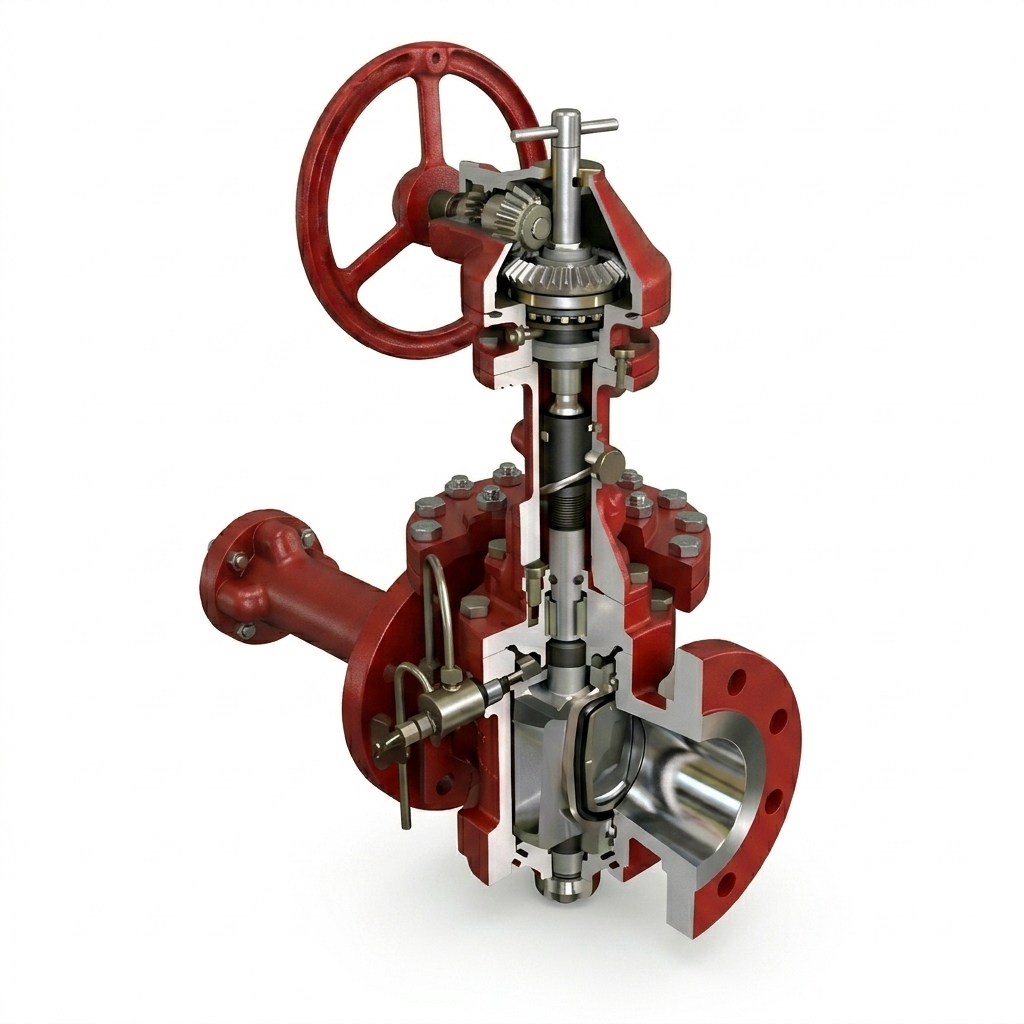


Wegman supplies the General Valve Twin Seal double block-and-bleed plug valve from Cameron, SLB — the proven single-body DBB solution for pipeline, terminal, and process plant applications. The Twin Seal simultaneously isolates pressure from both the upstream and downstream sides, with a bleed port between the two seats for immediate, verifiable seal integrity confirmation. This plug valve replaces what would otherwise require two isolation valves and a bleed valve in series — reducing leak paths, saving space, and delivering consistently provable zero-leakage performance in a single compact body. Unlike conventional ball and gate valves where sealing surfaces rotate under load, the Twin Seal’s mechanical slip-retraction design lifts both seating slips completely clear of the body bore before rotating, eliminating seal abrasion entirely — achieving bubble-tight dual sealing without reliance on line pressure to energise the seal.
Slips are available in more than 17 elastomer options covering most service conditions, with all seals bonded in house by Cameron. Stem packing is Low-E certified to API 622 and API 624 across the range, with the Model 8800A offering full ISO 15848-1 CO3 endurance certification for the most demanding fugitive emissions requirements.
Applications:
– Pipeline pumping stations and terminals
– Refinery bulk loading terminals
– Aviation and marine fueling systems and hydrant isolation
– Crude oil and refined products metering and measurement
– Multiproduct manifolds and product segregation
– Tank storage isolation
– Industrial process plants
– Direct burial underground intstallations
– Renewable fuels and ammonia service
GENERAL VALVE Twin Seal
Key Features and Benefits
Pressure Relief System:
All DBB valves in liquid service require a pressure-relief device, to comply with API Spec 6D. Because the Twin Seal holds bubble-tight on both seats, trapped body cavity pressure can build dangerously from ambient temperature changes alone. Three configurations are available. The manual bleed is standard on all valves, opened after closing to verify seal integrity. The differential thermal relief (DTR) system automatically relieves excess body cavity pressure to the upstream line at 25 psi above upstream pressure — standard on automated valves and essential on motorised valves where the actuator torque limiter is typically bypassed during unseating. The safety block and DTR houses all working components in a compact carbon steel manifold for applications requiring maximum fire safety and incident control.
Double Block-and-Bleed in a Single Body:
Both upstream and downstream seats are sealed simultaneously by mechanical wedge action, with a bleed port between them for immediate integrity verification. This replaces a traditional two-valve and spool-piece arrangement in a single compact body — reducing potential leak paths and simplifying compliance in metering, custody transfer, and manifold applications. Because sealing is mechanical rather than pressure-assisted, the Twin Seal holds consistently at both high and low differential pressures — including in vacuum service where floating-seat designs fail to achieve a complete seal.
Low Emissions:
Stem packing is Low-E certified to API 622 and API 624 as standard across all pressure classes. The Model 8800A provides full fugitive emissions qualification certified to ISO 15848-1 at the highest endurance class of CO3, making it the specification of choice for applications subject to the most stringent emissions requirements.
Frictionless Rotation:
Both slips retract fully and perpendicularly from the body bore before the plug turns — zero seal-to-body contact during operation. This eliminates the abrasive wear that scores seating surfaces in conventional ball and gate valve designs, dramatically extending slip seal service life even under high-cycle conditions.